




The Gulf banking sector is poised for continued growth and resilience through 2025, driven by high levels of capital and ongoing economic transformation across Gulf Cooperation Council (GCC) countries. According to Al Khaleej Online, the regional financial environment benefits from diversified economic agendas, large-scale development projects, financial stability, and balanced monetary policies.
Structural Transformation as a Catalyst
A report by Ernst & Young (EY) anticipates that the GCC banking sector will maintain its strength in 2025, supported by robust capital bases. This projection is anchored in the structural shifts underway in the region, notably efforts to diversify economies away from oil dependency. Leading initiatives, such as Saudi Arabia’s Vision 2030 and Oman Vision 2040, underline this transition, aiming to establish sustainable, innovation-driven economies.
These national strategies are fostering an investment-conducive environment. Financial sector reforms, implementation of large infrastructure projects, and increasing foreign direct investment are key pillars ensuring sectoral growth. In addition, balanced monetary policies and improved regulatory frameworks across countries such as Saudi Arabia, the UAE, and Kuwait further reinforce the sector’s stability.
Growth Despite Global and Regional Headwinds
Despite a favorable outlook, the sector is not without challenges. Analysts highlight vulnerabilities tied to oil price fluctuations, inflationary pressures, and rising borrowing costs. These risks, if not mitigated, could affect credit conditions for individuals and businesses. Nonetheless, diversified income sources and digital transformation strategies are viewed as counterbalancing forces capable of sustaining sector growth.
The integration of digital banking and financial technology is accelerating across the region. Enhanced regulatory environments, especially in Bahrain and the UAE, are fostering fintech innovation. These developments not only improve operational efficiency but also contribute to expanding the banking customer base and services portfolio.
Country-Specific Developments
Each GCC country contributes uniquely to the overall momentum of the banking sector:
- Saudi Arabia leverages its large-scale projects under Vision 2030, including NEOM and The Line, to boost lending and attract investment. Government support for financial sector reforms and digitalization has elevated investor confidence.
- Qatar continues expanding its natural gas output, generating substantial revenue to support economic diversification. This, in turn, underpins banking sector stability and capacity for credit growth.
- The UAE benefits from deep capital markets and diversified financial institutions, allowing it to channel resources efficiently into infrastructure and private sector growth.
- Kuwait has demonstrated steady progress, buoyed by monetary stability and government-led financial policies. Kuwaiti banks are enhancing their roles as regional financial hubs through capital consolidation and expanded lending capabilities.
- Bahrain has concentrated efforts on revamping its private investment laws and stimulating the credit market. A streamlined regulatory environment has been key to nurturing fintech growth and banking innovation.
- Oman, aligned with Vision 2040, is working to widen its non-oil economic base through banking sector reforms and better access to development financing.
Financial Strength and Capitalization
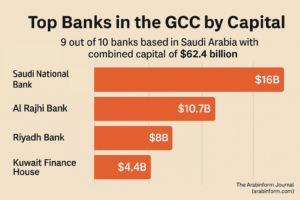
A comparative overview of the top ten banks in the GCC region, ranked by capital, shows nine out of ten institutions are based in Saudi Arabia, with a combined capital of $62.4 billion. The Saudi National Bank (SNB) tops the list with $16 billion, followed by Al Rajhi Bank ($10.7 billion) and Riyadh Bank ($8 billion). The only non-Saudi bank on the list is the Kuwait Finance House, with a capital base of $4.4 billion. This underscores the dominance of Saudi Arabia’s banking system in the regional financial landscape.
Resilience Amid Economic Shifts
Despite external uncertainties, such as geopolitical tensions and shifts in global interest rates, the Gulf banking sector continues to benefit from long-term strategies aimed at financial inclusion, technological adoption, and customer-centric innovations. Regulatory bodies across the GCC are increasingly focusing on consumer protection, enhanced transparency, and sustainable banking practices.
Moody’s recent assessments reflect cautious optimism. In February, the agency upgraded Oman’s banking sector outlook from “stable” to “positive” and maintained positive ratings for Saudi Arabia and the UAE. This suggests an improving risk profile across the region, though Bahrain and Kuwait retained their stable outlooks.
Future Outlook and Policy Priorities
The sustainability of current growth trends will largely depend on the region’s ability to maintain macroeconomic stability, foster private sector participation, and reduce fiscal dependence on hydrocarbons. Policy shifts towards green financing, climate-resilient infrastructure, and digital innovation are likely to shape the next phase of growth.
Moreover, public-private partnerships and improved credit accessibility are expected to remain central to economic policy across the GCC. By balancing fiscal discipline with developmental ambitions, Gulf governments aim to create a robust foundation for banking sector expansion beyond 2025.