

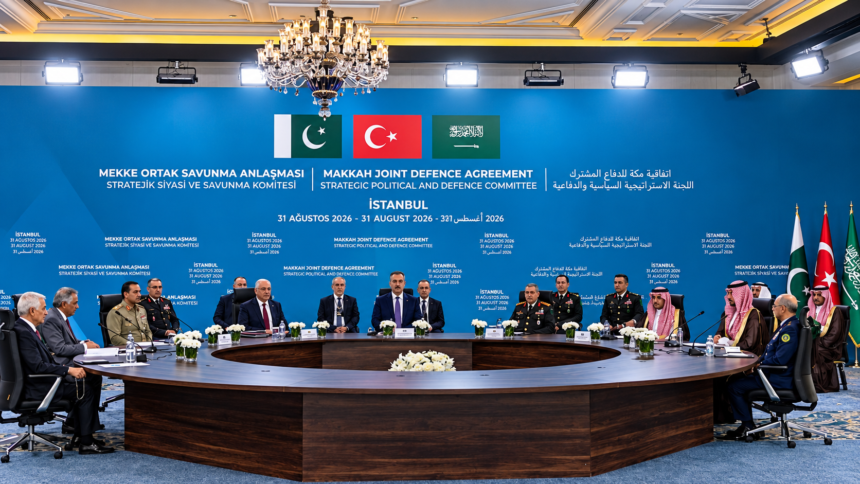
The Makkah Joint Defence Agreement, signed by Saudi Arabia, Türkiye and Pakistan on August 7, is an important development in Middle Eastern security. According to the official Saudi statement, an armed attack on any one of the three states will be regarded as an attack on all, while the agreement also provides for broader defence cooperation.
Its significance may reach beyond those commitments. For decades, the region’s security architecture has depended heavily on external powers, particularly the United States, which retains extensive defence relationships and a substantial military presence across the Gulf. The new agreement suggests that major regional powers want a greater role in shaping the security environment around them.
That raises a larger question: will emerging security arrangements bring the countries of the region closer together, or create another layer of division?
A move towards greater regional responsibility
There is nothing unusual about states seeking stronger defence partnerships when the regional environment becomes uncertain. Saudi Arabia has expanded its military capabilities and diversified its international relationships. Türkiye combines NATO membership with a substantial domestic defence industry. Pakistan brings considerable military experience and a longstanding strategic relationship with Saudi Arabia.
Bringing these three countries closer together therefore has a practical logic.
But the agreement need not be interpreted simply as the birth of an exclusive bloc. At the first Strategic Political and Defence Committee meeting on August 31, the three countries said they would pursue de-escalation, peaceful resolution of crises and “cooperative security” supporting an inclusive and lasting peace. They also agreed to establish a permanent secretariat in Saudi Arabia.
The real question is whether collective deterrence can coexist with a wider regional security conversation.
Iran is part of the equation
Any discussion of a new Middle Eastern security architecture faces a structural reality: Iran is one of the region’s major political, economic and military powers. Its geography and position on the northern side of the Strait of Hormuz make it inseparable from discussions about Gulf maritime security.
Tehran’s initial reaction to the Makkah agreement was notably measured. On August 10, Iran’s Foreign Ministry said it saw no reason to fear the pact and described the shift towards greater reliance on regional capabilities as potentially constructive, provided emerging arrangements are inclusive and reflect regional realities.
That does not erase deep disagreements. The Saudi-Iran rapprochement that began in 2023 demonstrated that regional rivals could reopen diplomatic space. But developments in 2026 have also shown how fragile that progress can be: planned Gulf-Iran talks on reopening the Strait of Hormuz were postponed in September amid renewed attacks and broader regional escalation.
The issue, therefore, is not whether political differences can disappear. It is whether mechanisms can be built that prevent disagreement from automatically becoming military confrontation.
Security does not have to mean exclusion
Military cooperation can strengthen deterrence, border security and defence readiness. But it cannot by itself resolve the political disputes that repeatedly generate regional crises.
Crisis communication, maritime coordination, early warning and incident-prevention mechanisms could eventually complement existing defence arrangements without requiring countries to abandon their alliances or agree on every political issue.
The Strait of Hormuz illustrates the shared vulnerability. According to the U.S. Energy Information Administration, oil flows through the strait averaged 20.9 million barrels per day in the first half of 2025, before falling to 4.9 million barrels per day in the second quarter of 2026 amid severe disruption.
Energy infrastructure, sea lanes and trade networks cross political boundaries. Their security is difficult for any one country to guarantee alone.
What role for the United States?
Greater regional responsibility should not be confused with the disappearance of American influence. Washington remains a major military, economic and diplomatic actor in the Middle East.
What is changing is the range of options available to regional governments. They can maintain relationships with the United States while simultaneously developing ties with Türkiye, Pakistan, China, Europe and other powers. This does not necessarily represent a rejection of Washington. It reflects diversification and a search for greater strategic autonomy.
What comes next
The temptation after any major defence agreement is to focus on who has gained and who has lost. A more consequential question is whether the Makkah pact can help regional states assume greater responsibility for security without hardening new permanent divisions.
Saudi Arabia, Türkiye and Pakistan have already begun institutionalising the agreement. The next phase will show whether it remains primarily a three-state collective-defence mechanism or develops links with wider regional diplomacy.
If it becomes another dividing line, the region will have gained another alliance but not necessarily greater security. If it contributes to broader crisis management, maritime coordination and dialogue, it could become part of something the Middle East has long lacked: a security architecture shaped more directly by the states that live with its consequences.
Disclaimer: Views expressed by writers in this section are their own and do not necessarily reflect The Arabinform Journal point of view.

Research Fellow at the International Studies Association . His primary research interest lies in international relations, transnational governance, international peace, and conflicts in the Middle East.