


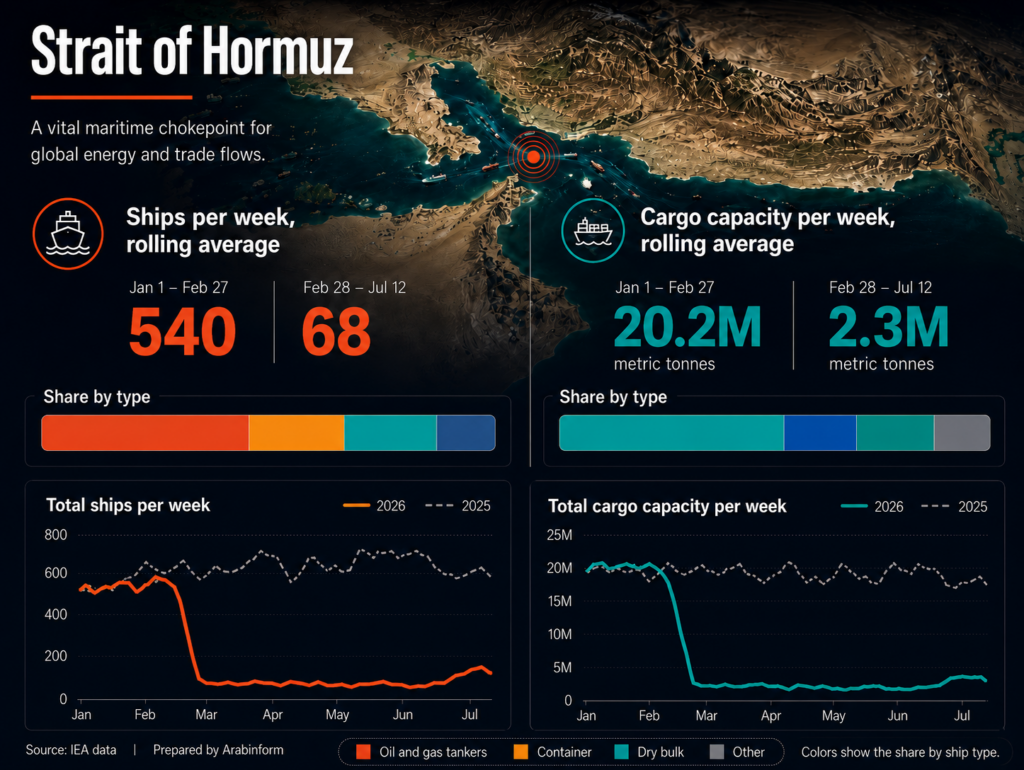
The Strait of Hormuz has long been treated as a narrow regional chokepoint with global importance. Today, however, it has become something more: a test of whether the international economy can remain stable when one of its most critical trade routes is exposed to sustained military and political pressure.
The emerging “post-Hormuz world” does not imply that the strait has lost its relevance. On the contrary, it describes a new reality in which governments, energy companies and financial markets can no longer assume that Gulf oil, gas and commercial shipping will move freely even during periods of regional tension. That change is forcing every major economy to reconsider its approach to energy security, maritime protection, inflation and strategic dependence.
A chokepoint becomes a global system
Hormuz is not merely a Gulf security problem. The International Energy Agency estimates that around 25% of seaborne oil trade crossed the strait in 2025; about 80% of those oil and petroleum-product flows went to Asia.
More than 110 billion cubic metres of LNG also passed through, representing almost one-fifth of global LNG trade, with no alternative export route for most Qatari and Emirati volumes. The same corridor carries more than 30% of globally traded urea, linking naval risk directly to food prices.
That exposure reaches every region differently. Asian importers face the most immediate supply shock. Europe is vulnerable through LNG, diesel and fertilizer markets. African and South Asian economies face higher import bills, weaker currencies and greater food insecurity. The Americas are less physically dependent on Hormuz, but not insulated from inflation, interest-rate pressure or financial volatility.
The IMF now projects global growth of 3.0% in 2026 and headline inflation of 4.7%, while explicitly assuming that the strait begins reopening in mid-July and returns to pre-war conditions only by March 2027. That assumption may already look optimistic as fighting intensifies again.
Four paths from here
The first and worst scenario is regional war. A broadened US-Israeli campaign could move from air and naval strikes towards attacks on power systems, ports and oil infrastructure, or even limited ground operations against strategic sites.
Iran could respond against Gulf facilities and activate allied forces in Iraq, Lebanon and Yemen. Reuters reported that Tehran had asked the Houthis to prepare to disrupt Bab al-Mandeb if Iranian power infrastructure were struck. Simultaneous pressure on Hormuz and the Red Sea would turn an energy shock into a generalized trade crisis, while making Gulf states direct participants rather than exposed bystanders.
The second, and most probable, scenario is managed attrition: no peace treaty, no credible negotiations, but no full invasion either. The conflict would settle into periodic missile attacks, maritime seizures, blockades and limited bombing campaigns.
Each side could claim deterrence while avoiding the costs of decisive escalation. Yet this “contained” outcome would still be economically corrosive. War-risk insurance, freight costs and oil-price volatility would remain elevated; governments would continue drawing on reserves; companies would accelerate stockpiling and investment in pipelines, renewables and domestic refining.
The real test is whether markets can treat repeated disruption as a manageable premium, or whether every new strike triggers a fresh global inflation cycle. The IEA reported that observed oil inventories had already been falling at an average rate of 3.8 million barrels a day since the conflict began, reducing the system’s capacity to absorb another prolonged interruption.
A third scenario is political rupture inside Iran. Military pressure, economic damage and elite rivalry could weaken the state enough to produce a leadership crisis or regime change.
But regime collapse would not automatically produce stability. It could fragment military command, create uncertainty over missiles and nuclear assets, and intensify separatist or factional conflict. A successor government might seek accommodation, yet the transition itself could be more dangerous than the present confrontation.
The fourth scenario is a narrow maritime armistice. This would not be a grand peace, and it would probably leave the nuclear dispute, sanctions and regional proxy networks unresolved. It could instead exchange verifiable freedom of navigation for limited sanctions relief, security guarantees and a monitored non-attack arrangement around critical infrastructure.
A unilateral US or Israeli retreat from stated demands appears unlikely; a negotiated narrowing of those demands is more plausible. Even then, shipping confidence would recover slowly because mines, damaged infrastructure and political mistrust would outlast any formal agreement.
A choice between bad outcomes
Hormuz has already redrawn the global order by turning energy security into maritime security and maritime security into macroeconomic policy. The least damaging outcome is a limited bargain that restores navigation without pretending to resolve the wider conflict.
The most likely is prolonged coercion below the threshold of total war. All available paths are therefore choices between bad and very bad outcomes; the difference lies in whether disruption remains expensive, or becomes systemically unmanageable.