


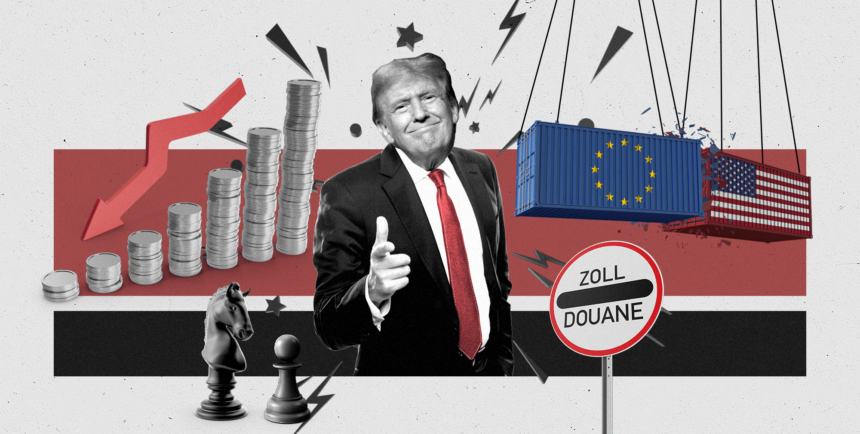
With Donald Trump now back in office as President of the United States, global markets and policymakers are bracing for a renewed wave of economic uncertainty. A detailed analysis published by Al-Qabas highlights the potential ramifications for the Gulf region and broader Middle East, driven largely by Trump’s protectionist trade agenda, tariff threats, and shifting global alignments.
Two months into Trump’s second term, early decisions from the White House have rekindled fears of unilateralism, trade wars, and economic fragmentation. His hardline stance on tariffs and trade policy—hallmarks of his first presidency—has re-emerged as a central theme. Observers point to rapid decision-making and unpredictability as sources of instability for trade-dependent economies, especially those in the Gulf.
According to The National, cited in the article, Gulf countries may not face immediate direct consequences but are highly exposed to secondary impacts due to the integrated nature of global supply chains and energy markets. These effects could manifest quickly, particularly if the Trump administration accelerates tariff enforcement and pulls back from multilateral trade frameworks.
Shifting Alliances and Trade Risks
During Trump’s first term, the Gulf region enjoyed relatively stable ties with Washington. This period coincided with the Abraham Accords and strengthening economic cooperation. However, experts now caution that such alliances could face strain, especially with Trump’s renewed focus on bilateralism and reduced U.S. engagement in regional diplomacy.
Tariff policies are expected to target specific sectors. For instance, aluminum exports—16% of which come from Gulf states—could be affected by U.S. import restrictions. Companies operating in these sectors may face reduced margins, costlier inputs, and logistical bottlenecks if retaliatory tariffs or new trade barriers are imposed.
The report highlights concern among traditional allies of the U.S. about the consequences of such protectionism. Countries relying heavily on trade with the United States for defense cooperation, financial aid, and security partnerships may find themselves at a disadvantage if they fail to align with Trump’s emerging policy direction.
Moreover, economists warn of potential cascading effects, including supply chain disruptions and heightened volatility in currency markets. If Trump extends tariffs or tightens trade restrictions, global demand could slow, pressuring exporters and energy producers alike.
Global System Under Pressure
Analysts cited in Al-Qabas note that Trump’s return comes amid growing questions about the post-World War II economic order. His administration’s tendency to retreat from multilateral institutions and challenge the role of the U.S. dollar could alter the global financial system in unpredictable ways. The weakening of collective trade frameworks may result in a fragmented landscape dominated by bilateral deals and geopolitical blocs.
This dynamic could also open the door to alternative trade routes and development programs. China’s Belt and Road Initiative, along with BRICS-led projects in Asia and Africa, may gain relevance as U.S. influence recedes. Nevertheless, these relationships are not without risks, as they are often tied to volatile currency arrangements, debt conditions, and political uncertainty.
As Gulf nations seek to diversify their trade and investment strategies, they are also confronting uncertainty about the future of dollar-pegged systems and export-linked dollar flows. Some economists anticipate that early moves to reintroduce U.S. tariffs could depress global demand for the dollar, leading to potential price fluctuations and speculative shifts in exchange markets.
Tariffs, the Dollar, and Energy Markets
The analysis underscores that retaliatory tariffs remain a major concern. The rise of protectionist policies could dampen global trade and undermine investor confidence in emerging markets. The Gulf, deeply embedded in global trade logistics, would find it difficult to isolate itself from these macroeconomic headwinds.
A further concern is the dollar’s role in regional exports. Many Gulf economies tie their revenues to the U.S. currency through oil exports and financial instruments. Should Trump’s policies trigger instability in demand or contribute to global monetary shifts, the Gulf could experience a knock-on effect in its external balances and fiscal planning.
On oil prices specifically, the article suggests that Trump’s return introduces new risks. Global uncertainty, protracted geopolitical disputes—especially regarding Ukraine—and weakening cooperation within OPEC+ could all drive oil price fluctuations. While some scenarios may push prices upward, prolonged trade frictions could suppress demand, putting downward pressure on oil revenues.
With Brent crude currently hovering near $70 per barrel, even slight geopolitical shocks could have significant consequences. The region’s fiscal outlook, closely tied to energy exports, remains vulnerable to Trump’s evolving global strategy.
Conclusion
Trump’s reinstatement as President of the United States signals a potential transformation in global economic governance. For the Middle East and Gulf in particular, the risks are multifaceted: trade disruption, tariff volatility, weakened multilateralism, and shifting currency dynamics. While Gulf nations may explore new partnerships and diversify trade routes, the road ahead is uncertain.
As outlined by Al-Qabas, the region’s policymakers must now prepare for a scenario defined by greater isolationism, competitive trade practices, and declining predictability in U.S. foreign economic policy. The full impact will depend on how quickly the Trump administration acts, and whether global institutions can adapt to the return of a more unilateral American approach.