


The expiration of extended OPEC+ production quotas in March 2025 marks a pivotal moment for the global oil market. Starting in April, eight of the alliance’s leading producers — Saudi Arabia, Russia, Iraq, the United Arab Emirates, Kuwait, Kazakhstan, Oman, and Algeria — are set to incrementally increase oil output by 140,000 barrels per day (bpd). By December 2025, total additional production is scheduled to reach 960,000 bpd. According to Forbes, signs are mounting that another extension may be necessary.
Demand Disruption: The Electric Vehicle Effect
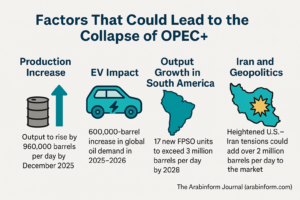 One of the most significant factors undermining oil demand is the accelerating shift to electric vehicles, especially in China. While the global oil demand rose by a total of 4.1 million bpd between 2023 and 2024, the projected increase for 2025–2026 is only 2.8 million bpd. China’s contribution is expected to be just 600,000 bpd—far lower than previous years. According to OPEC estimates, demand for gasoline in China has already begun to decline. In December 2024, consumption dropped by 3.4% year-over-year, equivalent to 120,000 bpd.
The trend is reinforced by rapid growth in China’s electric vehicle market. According to the China Association of Automobile Manufacturers, sales of electric and plug-in hybrid vehicles rose 34% year-over-year in December 2024, reaching 1.6 million units. The share of these vehicles in new car sales rose from 37.7% to 45.7%, and is expected to surpass 50% in the coming years. Trade restrictions on Chinese EV exports by the United States and the European Union may further encourage Beijing to prioritize its domestic market, thereby accelerating the displacement of traditional internal combustion vehicles and weakening oil demand.
South America: Output Expansion Gains Momentum
At the same time, a surge in oil production is occurring in South America, where Brazil and Guyana commissioned 15 floating production storage and offloading (FPSO) units between 2019 and 2023, with a combined capacity of 2.4 million bpd. ExxonMobil and Petrobras, the operators of these projects, plan to bring an additional 17 FPSO units online by 2028, with a collective output exceeding 3 million bpd. Of this, 750,000 bpd is attributed to the Stabroek block and 2.3 million bpd to other Atlantic basin operations.
Much of the capital investment in such ventures is made during the construction phase, meaning operators can continue production largely independent of oil price fluctuations. This is particularly relevant following Brazil’s recent formal entry into OPEC+, which coincided with the launch of the FPSO Almirante Tamandaré with a capacity of 225,000 bpd at the Buzios field. Although Brazil currently does not participate in quota-setting, its accession to the alliance appears to be more of a symbolic diplomatic gesture than a strategic commitment.
North America: Export Infrastructure Expansion
In North America, efforts are concentrated on enhancing oil export infrastructure. Canada completed the modernization of the Trans Mountain Pipeline (TMPL) in 2024, increasing its capacity from 300,000 to 890,000 bpd. This upgrade facilitates the export of Alberta’s oil to British Columbia, thereby expanding Canada’s global market reach.
Simultaneously, the U.S. Maritime Administration (MARAD) approved the Texas Gulflink project in February 2025. This deepwater oil terminal in the Gulf of Mexico will have a capacity of 1 million bpd. Alongside the earlier-approved SPOT terminal (2 million bpd), the new facility will handle Very Large Crude Carriers (VLCCs), significantly boosting the U.S.’s ability to increase exports. In 2024, U.S. oil output reached a record high of 13.2 million bpd. Future trends will depend on factors such as regulatory changes on federal lands, a legacy of the Trump administration, and the evolution of OPEC+ itself.
Iran: A Potential Catalyst for Disruption
Beyond structural shifts in supply and demand, a political trigger may be required to dissolve OPEC+. According to the U.S. Energy Information Administration (EIA), the Middle East had a spare production capacity of 4.8 million bpd in December 2024—the highest level since mid-2021. This surplus reflects restrained output by major producers amid weakening demand.
Yet, for OPEC+ to collapse, more than fundamentals are needed—a geopolitical flashpoint could act as the breaking point. Rising tensions between the United States and Iran may provide that spark. Should Washington intensify pressure on Tehran, prompting a shift in Iran’s nuclear policy, more than 2 million bpd of Iranian “legal” oil could flood the market. This volume, accessible not only to China but also other large importers, could make balancing global supply an impossible task for OPEC+ members.