

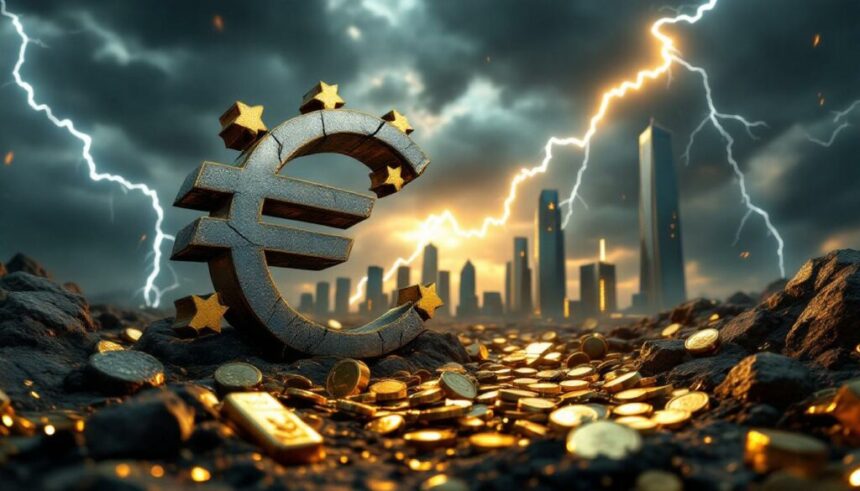
Europe’s longstanding image as a secure and rules-based destination for global investment is facing its most serious credibility test in decades. The European Union’s decision to freeze Russian sovereign assets for an indefinite period, and the public debate surrounding their possible confiscation, has triggered deep concern among strategic investors – particularly from the Arab Gulf and China. These actions have exposed what many now see as a dangerous shift: the politicization of financial norms once considered untouchable.
For global capital that relies on predictability, legal clarity, and immunity of sovereign funds, recent developments suggest that Europe can no longer be counted on to separate financial governance from geopolitical intent. This realization is quietly – but decisively – changing how major international investors view the continent.
Legal Norms Undermined by Political Agendas
For decades, Europe was seen as the benchmark for legal certainty in global finance. The principle of sovereign immunity, the sanctity of property rights, and insulation from arbitrary political decisions were core to its attractiveness. The freezing of Russian state reserves – without a legal end date – and the open discussion of using them to finance external political objectives has undermined these assumptions.
The issue, for many global investors, is not the specifics of the Russia case, but the precedent being created. If sovereign reserves can be immobilized indefinitely based on political calculations, what protection remains for other nations in future disputes? The legal environment in Europe has moved from being rules-based to being perceived as contingent – conditional on shifting geopolitical priorities.
Arab and Chinese Investors: From Strategic Patience to Strategic Doubt
In 2023, the total value of foreign direct investment (FDI) from Gulf Cooperation Council (GCC) countries into the EU reached €215.2 billion. This is not annual flow, but the total stock of capital currently placed in the European economy. It shows just how deeply tied Gulf sovereign wealth funds are to Europe.
According to GlobalSWF data, Gulf state-owned funds invested $56.3 billion globally in the first nine months of 2025 – 28% of which went to Europe, the highest share in over five years. Funds such as Saudi Arabia’s Public Investment Fund (PIF), the Abu Dhabi Investment Authority (ADIA), and the Qatar Investment Authority (QIA) continue to view Europe as a core part of their portfolios.
China has also built up a major investment presence in Europe over the past two decades. By the end of 2022, Chinese cumulative FDI in the EU stood at around €140 billion. Key Chinese investments include energy grids, transport infrastructure, high-tech firms, and logistics hubs like the Port of Piraeus in Greece.
Unlike speculative financial actors driven by short-term trends, sovereign wealth funds in the Arab world and institutional investors in China operate with long-term strategic visions. Their decisions are built on the assumption that capital placed abroad will remain insulated from political volatility. The recent European shift has disrupted that assumption.
Even though the EU stopped short of outright confiscation, the damage lies in the fact that such a move is now openly discussed within official institutions. It signals that legal protections – once thought absolute – may now be subject to interpretation or revision. This perception introduces a new kind of systemic risk for investors whose primary interest is long-term security, not short-term gain.
Investment Flows Are Adapting – Quietly and Systematically
There is no visible panic in the markets, but the realignment is underway. Investment plans involving European assets are being re-evaluated. Risk assessments are being updated to account for new political uncertainties. Discussions around portfolio diversification are increasingly favoring jurisdictions perceived as more neutral or less susceptible to geopolitical policy swings – particularly in Asia, the Middle East, and parts of the Global South.
This transition is gradual but deliberate. Sovereign and institutional investors do not react impulsively, but once confidence is shaken at a strategic level, reversals are rare. Projects are not being canceled, but new capital is being redirected. The reputational damage – not just to individual countries, but to Europe as a whole – is already beginning to affect future capital flows.
A Structural Shift in Global Investment Logic
The impact of these developments reaches beyond immediate asset freezes or diplomatic tensions. What is unfolding is a structural shift in how Europe is positioned within the global financial system. Once viewed as the safest harbor for international reserves, it is increasingly seen as vulnerable to politicized decision-making.
This shift has wide-ranging implications. Investors now must ask: If legal norms can be suspended in the case of one country, what prevents similar actions in other contexts? Which reserves are truly protected – and where? For strategic investors managing hundreds of billions of dollars, such questions are not theoretical – they guide capital allocation decisions for decades ahead.
Europe’s Diminishing Role as a Financial Safe Haven
What Europe faces is not simply a reputational challenge, but a strategic one. Trust is a foundational element of global finance. It is slow to build, easily damaged, and exceedingly difficult to restore. The recent asset freeze signals that political calculations can override financial norms – a reality that contradicts the legal stability Europe has historically promised.
Even if no confiscation occurs and legal safeguards are reaffirmed, the perception has shifted. Europe is no longer viewed as immune to the fusion of politics and financial governance. This may not result in immediate economic disruption, but it introduces a permanent element of caution – particularly among the very investors who once considered Europe the cornerstone of long-term capital security.
A Quiet Withdrawal, A Lasting Consequence
A new reality is taking shape: for Arab and Chinese investors, Europe no longer offers the unquestioned stability it once did. The decision to freeze sovereign assets indefinitely has crossed a psychological and strategic threshold. It has reframed Europe not as a neutral platform for global finance, but as an arena where politics can–and does–influence the fate of foreign capital.
This quiet withdrawal of confidence, while not yet visible in economic statistics, will likely leave a lasting imprint. In a world where financial ecosystems are increasingly multipolar, credibility is currency. And Europe’s credibility, in the eyes of key global investors, has been fundamentally compromised.