



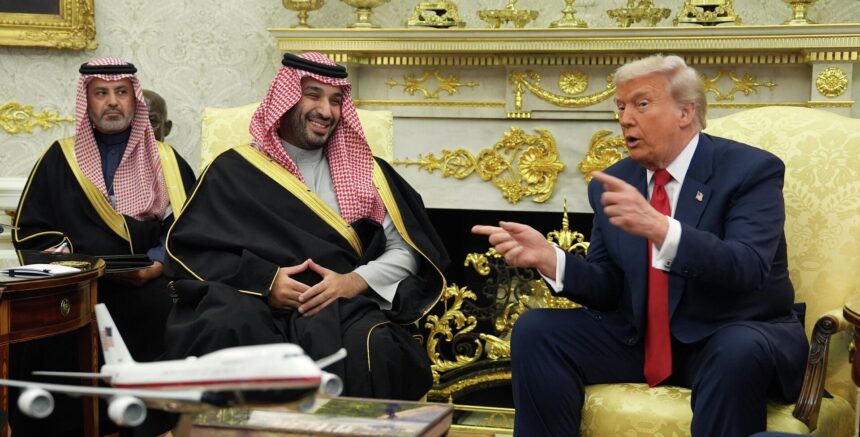
A new stage of global competition for critical minerals is unfolding, marked by a deepening alliance between the United States and Saudi Arabia. The recent agreement signed by both countries signifies more than a diplomatic formality—it outlines a long-term strategy to restructure global supply chains and challenge China’s dominance in rare earth processing and uranium resources.
As reported by Vostochnaya Tribuna, this trilateral agreement—focused on mineral security, industrial cooperation, and nuclear energy—signals a transition from reactive policies to proactive industrial and technological alignment. It comes amid growing concerns about the vulnerabilities of Western economies to supply chain disruptions and resource nationalism.
Building an Alternative Supply Chain
The foundation of the agreement is a broad framework to secure all stages of critical mineral production—from exploration and extraction to the manufacturing of components essential for defense systems, green energy, and digital ecosystems. Unlike previous attempts to reduce reliance on foreign suppliers, this initiative is notable for its depth, financial scale, and strategic backing by both governments.
The goal is not simply economic efficiency but geopolitical insulation. With rare earths being central to defense technologies and renewable energy, the creation of a resilient, diversified supply network is a national security priority for Washington. For Riyadh, it represents a key element in its diversification strategy, moving away from oil dependency toward becoming a critical hub in the future energy economy.
Industrial Cooperation at the Core
At the heart of the agreement lies a joint industrial project: the construction of a rare earth processing plant in Saudi Arabia. The financial model is revealing—49% of the venture will be funded by the US Department of Defense, while 51% will remain under the control of Ma’aden, Saudi Arabia’s state mining company. This split guarantees strategic oversight by both parties.
The plant will process key rare earth elements, including heavy elements such as dysprosium and terbium, used in the production of permanent magnets for advanced military systems and electric vehicles. The facility is expected to integrate Western technologies while leveraging Saudi Arabia’s advantage in low-cost, renewable energy—a factor that could make the project globally competitive.
Such cooperation not only reduces Western exposure to Chinese supply chains but positions Saudi Arabia as a new regional center for critical mineral processing. In addition, the streamlined regulatory environment—particularly the faster licensing procedures—may attract further investment from African countries with untapped rare earth reserves but insufficient processing capacity.
Strategic Dimension of Nuclear Cooperation
A third dimension of the alliance addresses the nuclear fuel cycle. The bilateral “123 Agreement” enables Saudi Arabia to extract and process uranium, particularly from the Jabal Sayid deposit, which holds substantial reserves of both rare earth elements and uranium ore.
The integration of Saudi resources with American nuclear technologies is seen as a step toward establishing a full nuclear fuel cycle within the Kingdom. In strategic terms, this reduces reliance on Russian and Chinese enrichment services, diversifies global nuclear fuel markets, and strengthens energy security in the Gulf region.
Forecasting a Shift in Global Market Dynamics
The agreement’s long-term implications stretch beyond economics. If successful, the US-Saudi initiative could catalyze a shift from the current China-centric rare earth system to a more multipolar structure. By 2030, global supply chains could be reorganized into three competing hubs: Chinese, US-Saudi, and potentially Australian-Japanese or European.
This fragmentation may encourage innovation and market efficiency but also heighten geopolitical tensions. The emergence of alternative hubs increases the likelihood of “resource nationalism,” as countries seek to assert control over strategic assets.
In parallel, Saudi Arabia’s low-cost energy and stable political framework could turn the Kingdom into a magnet for regional capital. African producers—particularly Malawi, Namibia, and South Africa—may redirect raw material exports toward Saudi processing facilities, bypassing China and reshaping trade flows across the Global South.
Anticipated Reactions and Strategic Risks
However, the creation of a new critical minerals axis will not occur uncontested. China is likely to respond with a combination of diplomatic, economic, and technological tools. Expected countermeasures include:
Tighter export controls on processing technologies and know-how;
Increased investment in Africa and Latin America to secure long-term influence;
Diplomatic and trade pressure on countries considering alignment with US-led supply chains.
Moreover, this realignment carries strategic risks that go beyond direct confrontation with China.
Environmental costs remain a key concern. Rare earth processing is energy-intensive and environmentally hazardous. Saudi Arabia’s capacity to align these operations with international green standards may be challenged, potentially complicating Western partnerships.
Political instability in the broader region could delay or derail long-term projects. Given the number of unresolved conflicts in the Middle East and North Africa, investor confidence remains sensitive to security disruptions.
Technological competition is also intensifying. While the US-Saudi initiative emphasizes resource extraction and processing, China maintains a significant lead in downstream applications and innovation. Bridging this technological gap will require sustained investment and policy coordination.
A New Chapter in Resource Geopolitics
The strategic collaboration between the United States and Saudi Arabia on critical minerals marks a turning point in global resource policy. Originally shaped by oil diplomacy, the alliance is being redefined around materials that underpin 21st-century technologies—from clean energy to AI and defense systems.
By 2030, if the outlined projects are implemented as planned, the global market may become more diversified but also more politically charged. While Washington and Riyadh are positioning themselves to benefit, the true impact will depend on whether this new supply architecture can provide stability—or whether it will generate new geopolitical fault lines.
In the best-case scenario, the move away from a single dominant supplier could increase resilience, attract new capital to the Global South, and accelerate innovation. In a more complex outcome, however, competition over strategic minerals could mirror the tensions of the fossil fuel era—only this time, with uranium and rare earths at the center of the contest.