


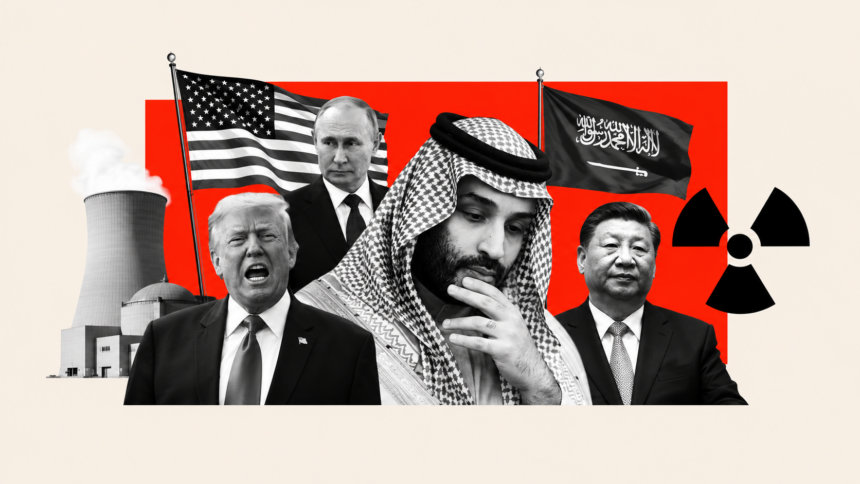
Saudi Arabia’s decision to anchor its civilian nuclear ambitions to the United States is more than an energy agreement. It is a strategic wager: Riyadh gains access to American technology and political support, while Washington attempts to prevent one of the Middle East’s most consequential emerging nuclear programmes from drifting toward Russia or China.
The wager became considerably riskier almost immediately. On July 22, 2026, US Energy Secretary Chris Wright and Saudi Energy Minister Prince Abdulaziz bin Salman signed a peaceful nuclear cooperation agreement, known as a Section 123 agreement, together with a bilateral safeguards arrangement. The US Department of Energy described it as the legal foundation for a decades-long, multibillion-dollar partnership.
Two days later, President Donald Trump said he would not proceed unless Saudi Arabia joined the Abraham Accords and normalized relations with Israel. He also stated that Saudi Arabia would not be permitted to enrich nuclear material—conditions that had not been publicly presented as part of the signing announcement.
That intervention crystallized the central question surrounding the deal: is nuclear cooperation a durable bilateral commitment, or another instrument through which Washington can periodically impose wider political demands?
Why Riyadh wants nuclear power
Saudi Arabia’s nuclear plans predate the latest diplomatic negotiations. Its National Atomic Energy Programme, approved in 2017, is intended to diversify the domestic energy mix, build technical capabilities and support Vision 2030. Nuclear generation could provide reliable electricity and desalination capacity while freeing more hydrocarbons for export or higher-value industrial use.
The programme also has an industrial dimension. Riyadh wants localization, workforce development, uranium exploration and participation in parts of the nuclear fuel cycle — not merely imported reactors operated indefinitely by foreign contractors. Cooperation outlined by Saudi Arabia and the United States in 2025 included large reactors, small modular reactors, training, uranium mining and waste management.
Yet Saudi ambitions have always contained a strategic subtext. Crown Prince Mohammed bin Salman has previously linked Saudi Arabia’s nuclear posture to Iran’s capabilities. This makes enrichment—the process that can produce reactor fuel but, at higher levels, weapons material—the most politically sensitive element of the programme.
From competitive tender to strategic alignment
Saudi Arabia originally pursued a competitive vendor process for its first large nuclear power plant. Industry accounts identified five prospective suppliers: America’s Westinghouse, Russia’s Rosatom, France’s EDF-led grouping, South Korea’s KEPCO and China’s CNNC. A tender process for the proposed Duwaiheen plant was repeatedly extended, with final offers reportedly sought for a facility of roughly 2.8 gigawatts.
Each bidder offered a different package of financing, construction experience, political alignment and localization. Russia was a particularly serious industrial competitor. Rosatom remains the leading exporter of nuclear power plants, with the world’s largest portfolio of reactors under construction abroad — making it more accurate to call Russia a global leader in international nuclear construction than simply the universal leader in all civilian nuclear activity.
By choosing a government-to-government framework with Washington, Riyadh has therefore prioritized strategic relations over a purely technological comparison. However, the 123 agreement enables US nuclear commerce; it does not by itself constitute a final engineering, procurement and construction contract for American reactors.
The price of the American option
Washington’s political requirements have shifted over time. Earlier negotiations focused on non-proliferation: whether Saudi Arabia would renounce uranium enrichment and spent-fuel reprocessing, accept stronger International Atomic Energy Agency inspections and follow the “gold standard” established by the US-UAE nuclear agreement.
More recently, nuclear cooperation became entangled with a broader package involving US security guarantees, arms sales and Saudi normalization with Israel. The July 2026 agreement initially appeared to separate the nuclear file from normalization. Trump’s subsequent statement restored that linkage, despite Riyadh’s insistence that recognition of Israel requires a credible and irreversible pathway to Palestinian statehood.
The real test is whether the normalization condition is the final political price — or merely the latest one. Congressional review could generate additional demands concerning enrichment, inspections, human rights, regional security or technology protection. Future administrations could reinterpret commitments again.
Other problems remain equally serious. Nuclear projects require enormous financing, specialized regulation, trained personnel, waste-management systems and construction discipline. The United States has strong reactor technology, but recent Western projects have suffered delays and cost overruns. Saudi Arabia must also decide how a large baseload nuclear plant will operate alongside rapidly expanding solar generation.
For Riyadh, the American agreement offers strategic legitimacy and access to advanced technology. For Washington, it keeps Saudi Arabia within a US-led non-proliferation and commercial framework rather than surrendering the market to Moscow or Beijing.
But the agreement’s credibility will depend less on ceremonial signatures than on policy consistency. If Washington repeatedly adds new political conditions, Saudi leaders may conclude that strategic alignment cannot substitute for contractual certainty. America has won the diplomatic round; it has not yet proved that it can deliver the reactor.