



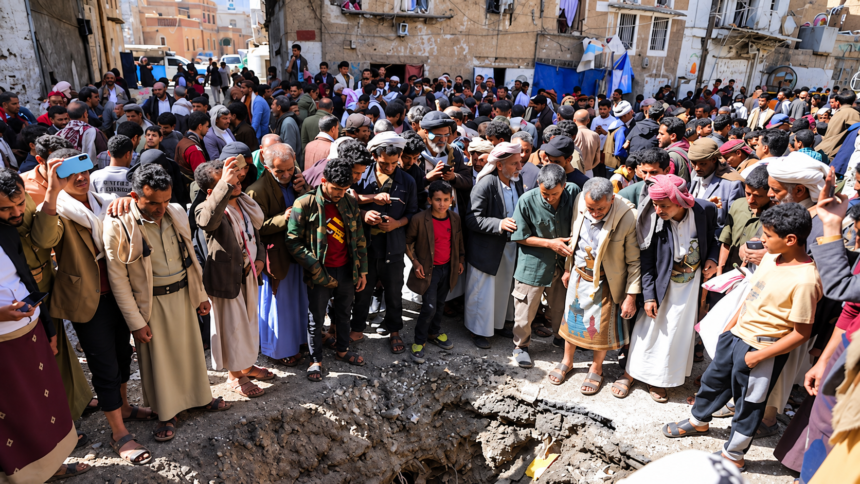
Yemen is often discussed as a conflict on the southern edge of the Arabian Peninsula. For the Gulf, however, Yemen is much more than that. Its stability is directly connected to the security of the Arabian Peninsula, the Red Sea, the Gulf of Aden, regional trade routes, energy infrastructure, and the wider economic transformation taking place across the Gulf. This makes Yemen not simply a security challenge, but a long-term strategic issue for the region.
For years, regional policy toward Yemen has largely focused on containing threats, supporting political negotiations, and preventing the conflict from producing wider instability. Those objectives remain important, but they are no longer sufficient. The region needs to begin thinking about what a stable Yemen could contribute to Gulf security and economic development.
From crisis management to regional strategy
The fundamental weakness of Yemen policy has been its short-term character. International and regional actors frequently respond when violence escalates and reduce their engagement when tensions decline. This creates a cycle of crisis management rather than strategic transformation. A more sustainable approach would treat political stability in Yemen as a regional investment.
A stable Yemen would reduce security risks along the southern approaches to the Arabian Peninsula, create better conditions for legitimate maritime commerce, and potentially contribute to the development of economic links between the Arabian Peninsula, the Horn of Africa, and the Indian Ocean. For Gulf states pursuing long-term economic diversification, these possibilities deserve greater attention.
The Red Sea and Gulf economies are connected
The security of the Red Sea cannot be separated from the economic interests of the Gulf. Shipping routes connecting Asia, the Middle East, Europe, and Africa pass through a maritime environment in which instability in Yemen can quickly become an international economic concern. But maritime security cannot be sustained through naval measures alone. It also depends on political stability on land.
If Yemen remains politically fragmented and economically weak, the risks surrounding its coastline will remain difficult to eliminate permanently. A regional strategy should therefore connect maritime security with political settlement, economic development, and accountable local governance.
Yemen’s political settlement must reflect realities on the ground
A durable political settlement cannot simply restore the institutional arrangements that existed before the war. Yemen’s political landscape has changed. Power has become more decentralized, regional political identities have strengthened, and local authorities and security structures have acquired greater importance. A successful settlement must acknowledge these realities.
This is particularly relevant to the Southern Question. The political aspirations of southern Yemenis have become an important part of the country’s future political debate. Addressing this issue directly through a legitimate political process would be more sustainable than postponing it indefinitely.
For neighboring Gulf states, a negotiated political framework that gives major regions and communities meaningful participation could help reduce the incentives for renewed conflict.
Hadramout deserves greater regional attention
Hadramout illustrates the connection between local governance, economic resources, and regional stability. Its geographical position on the Arabian Sea, its natural resources, and its proximity to the Gulf give it significance beyond Yemen’s domestic politics. Yet economic resources can become a source of instability when local populations do not see transparent and equitable management of those resources.
A future political settlement should therefore establish clear mechanisms for local governance, resource management, public revenues, and development. For Gulf states, supporting transparent economic institutions in Yemen could ultimately be more valuable than repeatedly responding to the consequences of institutional weakness.
A Gulf role beyond security
The Gulf’s role in Yemen should not be defined exclusively through security. There is also an opportunity for economic diplomacy. Infrastructure, ports, energy, telecommunications, education, healthcare, and trade could become components of a broader regional strategy for stabilizing Yemen.
Such engagement should be based on transparent institutions and local participation. The objective should not be to create dependency, but to create economic incentives for stability. A Yemen that can trade, invest, develop its ports, manage its resources, and provide basic services is less likely to become a persistent source of regional insecurity.
The strategic choice ahead
The region now faces two broad policy approaches. One is to continue managing Yemen primarily as a recurring security crisis. The other is to treat Yemeni stability as a long-term regional strategic objective involving diplomacy, governance, economic development, and maritime security. The second approach requires patience.
Political settlements cannot be engineered overnight, and economic reconstruction cannot substitute for political legitimacy. But neither can security measures substitute for a functioning political order. For the Gulf, Yemen’s future should therefore be viewed not only through the question of how to prevent the next crisis, but also through the question of what regional stability could look like if Yemen finally moves beyond permanent conflict.
The Arabian Peninsula cannot achieve its full economic and strategic potential while one of its most geographically important countries remains trapped in political instability. Yemen’s stability is therefore not merely a Yemeni objective. It is a Gulf interest.
Disclaimer: Views expressed by writers in this section are their own and do not necessarily reflect The Arabinform Journal point of view.

Yemeni journalist, writer and political researcher from Hadramout, southern Yemen. His work focuses on Yemeni politics, the Southern Issue, governance, conflict resolution and regional affairs.