


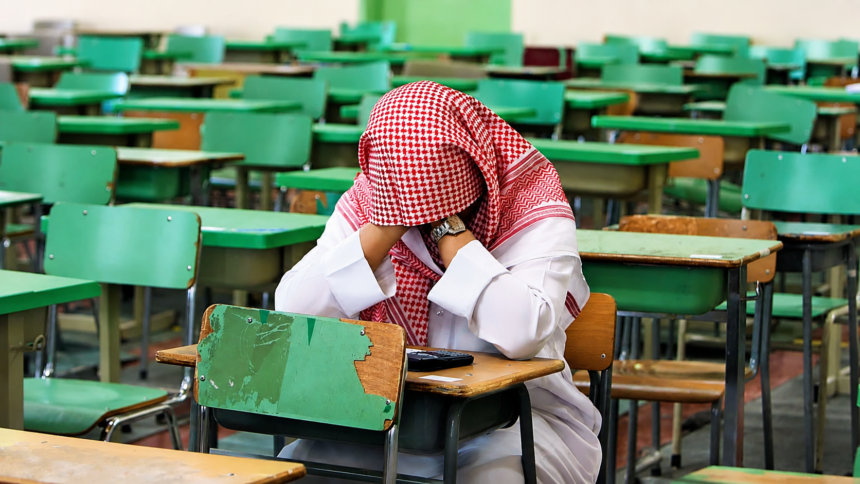
Across the Gulf, education has become one of the most visible components of economic transformation. Governments have built new universities, expanded digital classrooms, financed scholarships and imported international academic institutions. Yet the central problem is increasingly difficult to solve with money alone: impressive educational infrastructure has not consistently produced equally impressive learning outcomes.
The paradox matters because Gulf diversification strategies now depend less on physical capital than on human capital. Artificial intelligence, advanced manufacturing, tourism, finance and other priority sectors require workers who can solve problems, adapt quickly and compete internationally. The region has largely solved the problem of putting young people into classrooms. The harder question is what they learn once they are there.
Money is no longer the main constraint
Education remains a major fiscal priority. Saudi Arabia allocated $53.6 billion to education in its 2025 budget, according to the Ministry of Finance. Across the Gulf, investment has also produced modern campuses, extensive technology infrastructure and growing networks of international universities.
But once basic access and infrastructure reach relatively high levels, additional spending delivers diminishing returns unless institutions improve with it. Computers cannot compensate for weak instruction; laboratories have limited value if students are not encouraged to experiment, question and apply knowledge.
The learning gap
International assessments expose this distinction. In the OECD’s PISA 2022 tests, Saudi 15-year-olds averaged 389 points in mathematics, 383 in reading and 390 in science, compared with OECD averages of 472, 476 and 485 respectively. Only 30% of Saudi students reached at least basic proficiency in mathematics, versus 69% across the OECD.
Saudi Arabia is not the only Gulf economy facing a gap. Qatar scored 414 in mathematics, 419 in reading and 432 in science — still below OECD averages, although its long-term PISA performance has improved substantially. TIMSS 2023, which included Saudi Arabia, Bahrain, Kuwait, Oman, Qatar and the UAE, similarly keeps attention focused on mathematics and science performance across the region.
These comparisons should not be treated as definitive rankings of national education systems. But they raise a harder question than how much governments spend: are students consistently acquiring transferable skills rather than simply progressing through formal education?
Teachers, curriculum and incentives
That shifts the debate from hardware to institutions. Teacher recruitment, professional development, classroom autonomy, assessment and school leadership increasingly matter more than another round of equipment purchases.
Curricula also face a difficult balance. Systems designed around memorisation and high-stakes examinations can produce credentials without necessarily cultivating analytical reasoning, communication or independent problem-solving. Reform therefore requires changes in incentives as much as changes in textbooks.
Education for an economy that no longer exists
For decades, Gulf education systems operated alongside labour markets in which government employment offered nationals relatively secure and attractive careers. That encouraged families and students to value degrees partly as gateways to public-sector jobs.
Diversification is changing that bargain. Private companies care more about demonstrable skills, productivity and specialization. A World Bank analysis of Saudi Arabia shows encouraging movement: among Saudi men working in the private sector, the share whose qualifications matched their occupations rose from 41% in 2015 to 62% in 2025; for women it increased from 51% to 60%. Yet the Bank also notes that stronger human-capital indicators have not automatically translated into stronger measured productivity.
The real test, therefore, is whether education can adapt as quickly as the economy it is supposed to serve.
Saudi Arabia’s reform challenge
Saudi Arabia is the Gulf’s largest and most consequential experiment. Vision 2030’s Human Capability Development Program explicitly targets curriculum modernization, teacher development, vocational pathways and closer links between education and employment. In 2024, more than one million students took the national NAFIS assessments, while over 19,000 schools underwent external evaluation and ranking, according to the program’s annual report.
Such mechanisms could make performance more measurable. But measurement matters only if weak results lead to changes in teaching, management and resource allocation.
From spending more to learning better
The next phase of Gulf education reform is therefore likely to be less glamorous than the first. It requires stronger teachers, clearer accountability, curricula built around reasoning rather than recall, better vocational education and deeper employer involvement in course design and training. Saudi initiatives linking technical education with private-sector partners point in that direction.
None of this means investment was misplaced. Modern infrastructure and broad access were necessary foundations. But they are foundations, not outcomes.
The Gulf has largely solved the problem of educational access. Its next challenge is much harder: turning education into human capital. Building universities is relatively easy. Building an education system that consistently produces competitive graduates is not.