



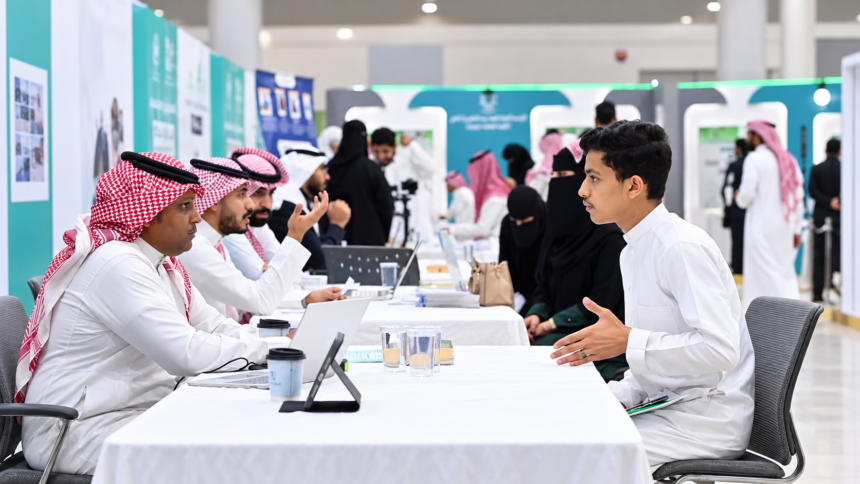
Young Arabs are entering the labour market with more education than previous generations, yet a university degree is increasingly failing to guarantee a suitable job. The International Labour Organization says youth unemployment in the Arab States reached 26.2% in 2025, more than twice the global rate of 12.4%. At least one in three young people in the region was also neither employed nor in education or training.
The numbers expose a deeper paradox. The region’s problem is no longer simply insufficient access to education. It is the widening gap between what education promises, what economies produce and what employers are prepared to pay for.
More graduates, but not enough graduate jobs
The ILO has previously found that youth unemployment in Arab States often rises with educational attainment. Its Arab States Employment and Social Outlook attributes this partly to an insufficient supply of high-skilled positions capable of absorbing growing numbers of graduates, as well as to weaknesses in aligning university and vocational programmes with employers’ needs.
This distinction matters. Describing the problem simply as a “skills mismatch” can place too much responsibility on universities and jobseekers. Even perfectly trained graduates cannot find professional employment if economies fail to generate enough productive, skilled positions.
Egypt illustrates the problem. The ILO noted in January 2026 that expansion in tertiary education has not been matched by sufficient job creation. It identified graduate unemployment, informality, fragmented training systems and limited private-sector absorption as major obstacles to young people moving into stable employment.
Jordan presents a similar pattern. According to the ILO, 35.3% of Jordanians aged 15–29 are NEET, while skills mismatch and limited job creation continue to constrain graduate employment.
The public-sector legacy
Another part of the paradox lies in expectations. For decades, public employment in many Arab economies offered educated citizens relatively stable salaries, predictable careers and social status. Education therefore became closely linked to expectations of formal salaried work.
But governments cannot expand public payrolls indefinitely. At the same time, private sectors in several countries remain dominated by smaller firms, informal employment or lower-productivity activities that may offer graduates salaries and conditions well below their expectations.
The result can be prolonged job searching rather than immediate acceptance of available work. From an economic perspective, this may appear as unemployment; from the graduate’s perspective, it can be a rational decision to wait for employment that justifies years of education. The key question is whether labour-market reforms can narrow this gap without simply pushing graduates into jobs for which they are overqualified.
Unemployment tells only part of the story
The 26.2% unemployment rate also requires careful interpretation. Unemployment statistics measure people actively participating in the labour force and searching for work. They do not fully capture young people who have stopped looking altogether.
That is why the region’s high NEET levels are potentially more worrying. Long periods outside employment, education and training can erode skills, reduce lifetime earnings and make later entry into formal employment harder. For young women, the transition is often further constrained by mobility, childcare responsibilities and social norms, as the ILO’s recent assessments of Jordan and Egypt show.
Technology may raise the stakes
Artificial intelligence adds another layer of uncertainty. The ILO estimates that 6.1% of jobs held by people aged 15–29 worldwide are in occupations highly exposed to AI-related change, including clerical and administrative positions that have traditionally served as entry points for educated young workers. Meanwhile, demand is expanding in areas such as science, health and engineering.
This could make the education-employment mismatch more dynamic: universities may improve curricula only to find that employers’ requirements have shifted again.
The policy challenge, therefore, is not simply to produce more graduates or more training programmes. Arab economies need stronger private investment, more productive firms, credible pathways from education into work, apprenticeships linked to real employers and better information about which skills are actually in demand.
The real test will be whether economic diversification can create skilled employment as quickly as education systems create skilled jobseekers. Without that shift, the region risks producing an increasingly educated generation whose qualifications rise faster than its opportunities.