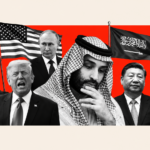


For decades, the Gulf’s international position was largely shaped by its close relationship with the United States. Security cooperation, energy markets and strategic partnerships formed the foundation of regional diplomacy. However, the global environment is changing rapidly. The rise of China, intensifying competition between major powers and the transformation of the global economy have created a new challenge for Gulf states: how to preserve strategic partnerships while expanding economic opportunities.
Saudi Arabia and the UAE have a practical approach, eschewing such a binary choice and instead constructing an increasingly extensive set of relationships intended to enhance investment, development of new technologies and economic diversification. This model is not about replacing one global partner for another; it is about giving itself greater leverage in a more multipolar world. The central shift is that Gulf foreign policy is becoming more closely connected to economic transformation.
China’s expanding economic role in the Gulf
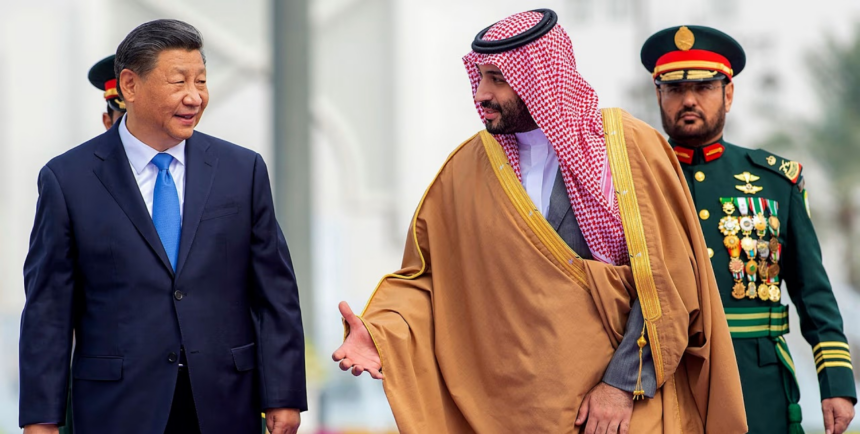
China has become one of the Gulf’s most important economic partners. Energy remains a central pillar of this relationship, with China’s position as one of the world’s largest energy consumers creating strong economic links with Gulf producers. However, the two connections are not limited to oil and gas. Increasingly, Chinese firms are partnering in a wide range of infrastructure, renewable energy, logistics, telecommunications, manufacturing and technological projects.
For both Saudi Arabia and the UAE, this cooperation brings not only investment and industrial know-how but also technical expertise. Saudi Arabia’s Vision 2030 and Abu Dhabi’s economic diversification strategy both rely on an inflow of foreign investment to build up their non-oil industries and develop sophisticated sectors; China is well placed to be a key part of such efforts, through cooperation on infrastructure, clean energy or industrial ventures. But greater cooperation with China isn’t tantamount to distancing oneself from alliances with countries in the West.
The West remains an essential partner
Despite discussions about declining Western influence, the United States and Europe remain highly important economic and strategic partners for Gulf states. American and European companies continue to play significant roles in finance, technology, defense cooperation and investment. The United States remains a key security partner for many Gulf countries, while European economies remain important sources of trade, investment and technological expertise.
Hence the Gulf’s approach does not amount to substituting Beijing in place of Washington. Saudi Arabia and the UAE want to be flexible and deal with the world as it exists right now. In an era of intensifying competition, middle powers need a wider choice of friends, not a reliance on just one international power. In the Gulf’s case, maintaining its links with both Beijing and Washington allows greater room to advance national interest.
Economic diversification is driving geopolitical flexibility
The deeper force behind this strategy is domestic economic transformation. Saudi Arabia and the UAE are no longer positioning themselves solely as energy exporters. They are seeking to become global hubs for investment, logistics, technology, tourism and innovation. Achieving these ambitions requires access to multiple markets, investment sources and technological ecosystems. These are the considerations driving many of these Gulf countries to build multi-regional alliances.
Partnership with China helps deliver economic and infrastructure development objectives, while dealings with Western countries bring enhanced access to finance, technology and security cooperation. It’s essentially a new sort of strategic autonomy. Not independence from major powers but rather the sort of economic leverage allowing countries to deal selectively with them for the purpose of achieving their national interests.
Policymakers should focus on managing partnerships, not choosing sides
The Gulf’s balancing strategy also presents challenges. Greater engagement with China requires careful consideration of issues such as technology security, supply-chain resilience and geopolitical competition. At the same time, maintaining strong Western partnerships requires continued trust and cooperation. Therefore, the challenge for the Gulf states isn’t about choosing a single side in a world-scale showdown, but rather maintaining various relationships to avoid national interests being juxtaposed against individualistic objectives.
From a policymaker’s point of view, the focus should be to develop an environment where the advantages of engagement in the international arena are maximized. Such an environment should be characterized by an improved investment framework, an enhanced investment climate, investment in human capital, and the use of foreign partnerships for sustainable economic growth.
In conclusion, the Gulf’s future lies in strategic flexibility Emergence of a multipolar world offers various new avenues and possibilities for Gulf states to increase their global footprint. Saudi Arabia and the UAE clearly present to the world that a middle power does not necessarily have to take a stance between opposing global powers, but with its economic strength and diplomatic maneuverability, it can effectively build relations with a multitude of powers.
The future of Gulf states is less about switching loyalties from one foreign master to another. Rather, it is about leveraging economic ties for national growth and political power. “The logic of the new model of the Gulf is simple: far from restricting, engaging multiple international partners fosters greater autonomy.” Given that the international arena is transforming due to growing competition, rather than being a follower, Saudi Arabia and the UAE would act as the builders of their own economic and strategic destiny.
Disclaimer: Views expressed by writers in this section are their own and do not necessarily reflect The Arabinform Journal point of view

Research Fellow at the International Studies Association . His primary research interest lies in international relations, transnational governance, international peace, and conflicts in the Middle East.