




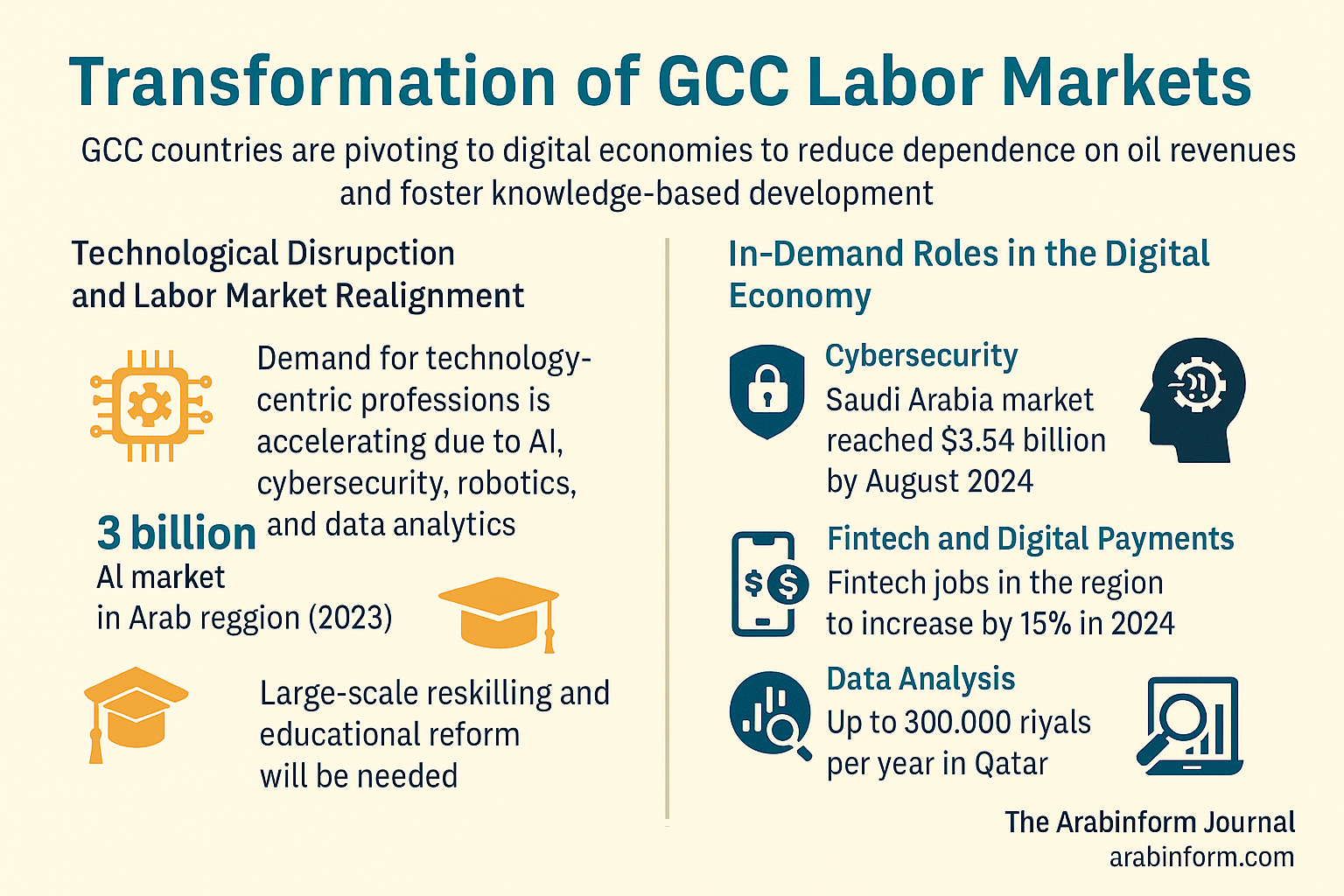
The Gulf Cooperation Council (GCC) countries are undergoing a fundamental transformation in their labor markets, driven by a strategic pivot toward a digital economy. This shift is closely tied to efforts aimed at reducing reliance on oil revenues and embracing knowledge-based development. According to Al Khaleej Online, the rapid expansion of digital sectors is reshaping employment dynamics, creating new opportunities while simultaneously introducing socioeconomic challenges.
Technological Disruption and Labor Market Realignment
GCC nations are navigating a historic turning point, characterized by an accelerated demand for technology-centric professions. The rise of artificial intelligence (AI), cybersecurity, robotics, and data analytics is reshaping employer requirements across the region. These trends are being fueled by structural reforms that promote economic diversification and long-term sustainability.
With governments focusing on innovation and technological competitiveness, demand has surged for digital skills in areas such as AI engineering, software development, and cybersecurity. However, a notable skills gap remains. A shortage of qualified local talent has led to increased reliance on expatriate labor, further emphasizing the urgency of investing in local education and workforce development.
Why Is This Transition Taking Place?
The underlying goal of this labor market shift is to support economic diversification away from hydrocarbons. GCC states are investing heavily in knowledge-driven sectors, aiming to develop digital infrastructure and foster innovation ecosystems. This reorientation is not limited to ICT industries; healthcare, renewable energy, manufacturing, and logistics are also increasingly integrating technological tools into their operations.
Emerging technologies like AI and robotics are now influencing both job creation and automation trends. This is leading to a complex employment environment where certain sectors experience exponential growth, while others face job losses due to automation.
In-Demand Roles in the New Digital Economy
Cybersecurity
Cybersecurity has become a top priority due to the escalating risk of cyberattacks. In Saudi Arabia alone, the sector reached $3.54 billion by August 2024, with annual growth forecasted at 20% through 2030. The demand for cybersecurity professionals is soaring, creating significant economic value and requiring rapid development of local expertise.
Artificial Intelligence
AI is at the forefront of the region’s digital strategy. Governments and private companies are incorporating AI applications to increase efficiency and reduce operational costs. Saudi Arabia, the UAE, and Qatar are leading this movement in the Arab world.
According to the International Data Corporation (IDC), the AI market in the Arab region exceeded $3 billion by the end of 2023. Organizations are investing in AI across sectors ranging from healthcare to urban planning, education, and logistics. The UAE’s Ministry of Economy has launched a dedicated initiative titled “Future Jobs,” focusing on upskilling workers to meet the growing demand in AI fields.
Fintech and Digital Payments
The expansion of digital financial services is driving employment growth in fintech, particularly in the UAE and Saudi Arabia. A report by KPMG highlights that fintech jobs in the region are expected to increase by 15% in 2024, as digital wallets and blockchain-based solutions become more widely adopted.
Data Analysis
Data analysts are increasingly sought after as companies rely more heavily on data-driven decision-making. In Qatar, experienced data professionals can command salaries of up to 300,000 riyals ($82,000) per year. The high demand for data expertise is creating lucrative career paths across industries.
Automation and Robotics
Automation is making significant inroads into sectors like oil and gas, manufacturing, and healthcare. These industries are investing in robotics to streamline operations and enhance service delivery. As a result, there is growing demand for specialists in the deployment, maintenance, and development of robotic systems.
Global Perspective: The Broader Impact
This transformation is not confined to the Gulf region. A report published by the World Economic Forum in November 2023 predicts that 44% of global workforce skills will be disrupted between 2023 and 2028. For GCC economies, this forecast aligns with efforts to transition from oil dependency to innovation-led development.
According to the report, the shift toward a digital economy will require large-scale reskilling and educational reform. For instance, Abu Dhabi University has introduced new academic programs in AI, financial technology, sustainability, and entrepreneurship to prepare graduates for the evolving labor market.
At the same time, data from the UK indicates that 7% of university graduates are joining the unemployed due to a mismatch between academic preparation and labor market needs. The World Economic Forum warns that 83 million jobs worldwide may be lost in the coming years if educational institutions do not align with industry demands.
Opportunities and Challenges
The economic upside of this transition is significant. As noted by economic analyst Ahmed Abu Qamar, the Gulf’s pivot toward digitalization is fostering more efficient economic models, improving energy utilization, and reducing exposure to oil price volatility. It also enhances the region’s attractiveness for global talent and investment.
However, the shift also presents challenges. Chief among them is the shortage of local digital talent, which amplifies dependence on foreign workers. Additionally, automation could eliminate large numbers of traditional jobs in agriculture, services, and public administration, raising concerns about social displacement.
Abu Qamar emphasizes the need for coordinated policy responses, including the development of national reskilling strategies and education reform. He points to Saudi Arabia’s Vision 2030 and other Gulf reform programs as important frameworks for ensuring that local workforces are prepared for the digital future.
Key to this strategy is the alignment of educational institutions with market needs, offering incentives for companies to invest in training and upskilling. This includes building innovation-friendly ecosystems and integrating real-world skills into academic programs.