



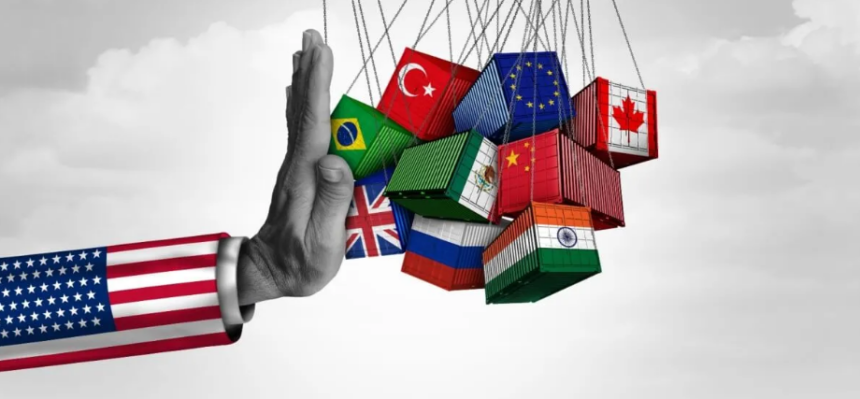
The trade policies initiated by former U.S. President Donald Trump continue to exert a measurable impact on global markets, including the Arab world. These policies, characterized by the imposition of tariffs and customs duties on imports into the U.S., were introduced to protect American industries. According to Al Jazeera, this shift has significantly altered trade balances and economic forecasts across the Middle East and North Africa (MENA) region.
Economic Fallout from Tariff Escalation
Trump’s economic strategy, marked by the imposition of new tariffs, was designed to limit foreign imports and encourage domestic production. However, these measures have sparked retaliatory actions from trade partners and triggered widespread instability in financial markets. The so-called “liberation day” initiated by Trump involved new tariffs that targeted nearly every nation engaged in trade with the U.S., including several Arab states.
For the MENA region, which maintains substantial trade relationships with the U.S., the repercussions have been significant. The total trade of American goods with MENA countries reached approximately $141.7 billion in 2024, according to figures from the Office of the United States Trade Representative (USTR). U.S. exports to the region alone amounted to $80.4 billion—an increase of 5.8% from 2023—while imports dropped by 1.6% to $61.3 billion. As a result, the U.S. trade surplus with MENA countries surged by 39.8%, reaching $19.1 billion in 2024.
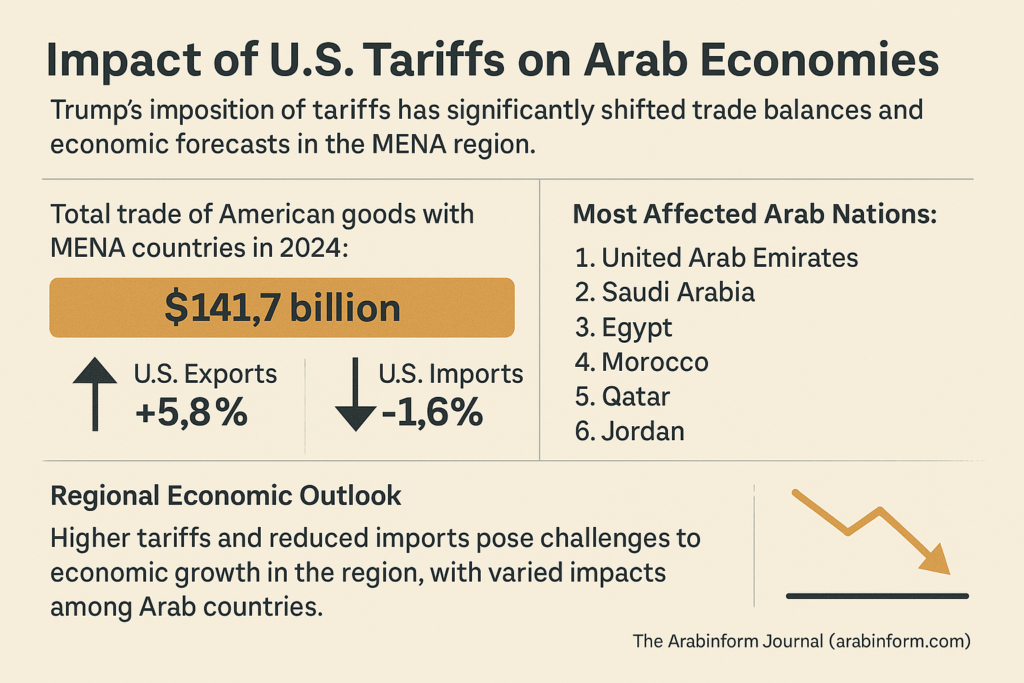
Most Affected Arab Nations
Among the Arab countries, the following ten have seen the most significant shifts in their trade balances with the United States:
1. United Arab Emirates (UAE)
The UAE remains the U.S.’s top trading partner in the region. Bilateral trade hit $34.4 billion in 2024, with U.S. exports increasing by 8.5% to $27 billion. Imports from the UAE rose by 12.9%, totaling $7.4 billion. The trade surplus reached $19.6 billion, up 6.9% from 2023.
2. Saudi Arabia
As the second-largest Arab trading partner, Saudi Arabia saw its total trade with the U.S. amount to $25.9 billion in 2024. U.S. exports decreased slightly by 4.8% to $13.2 billion, while imports fell by 19.9% to $12.7 billion. The surplus grew dramatically—up by 121.6%—to $500 million.
3. Egypt
Bilateral trade between the U.S. and Egypt reached $8.6 billion in 2024. U.S. exports increased by 36% to $6.1 billion, while imports grew by 6.7% to $2.5 billion. The surplus expanded to $3.6 billion, marking a 69.4% increase.
4. Morocco
Total trade with Morocco reached $7.2 billion. U.S. exports surged by 37.3% to $5.3 billion, while imports fell by 12.3% to $1.9 billion. This led to a 57.1% rise in the trade surplus, which stood at $3.4 billion.
5. Qatar
Trade volume between Qatar and the U.S. totaled $5.6 billion. U.S. exports decreased by 18.3% to $3.8 billion, and imports declined by 10.3% to $1.8 billion. The surplus decreased by 24.5% to $2 billion.
6. Jordan
U.S.-Jordan trade reached $5.4 billion. American exports to Jordan rose by 30.9% to $2 billion, while imports climbed by 15.4% to $3.4 billion. However, Jordan ran a trade deficit of $1.4 billion, 2.3% lower than in 2023.
7. Kuwait
Kuwait’s total trade with the U.S. was $4.1 billion. Exports from the U.S. dropped by 14.7% to $2.4 billion, and imports decreased by 2.4% to $1.6 billion. The surplus declined significantly, by 32.9%, to $768.2 million.
8. Algeria
Trade between the U.S. and Algeria amounted to $3.5 billion. American exports fell by 15.5% to $1 billion, while imports decreased by 18.7% to $2.5 billion. The trade deficit with Algeria shrank by 20.9% to $1.5 billion.
9. Oman
Total trade reached $3.3 billion. U.S. exports to Oman grew modestly by 5.1% to $2 billion, while imports decreased by 20.2% to $1.3 billion. The trade surplus rose sharply by 210.1% to $634 million.
10. Bahrain
Bahrain’s trade with the U.S. stood at $2.9 billion. American exports declined by 1.8% to $1.6 billion, and imports fell by 3.3% to $1.2 billion. The resulting surplus dropped by 13.3% to $441.9 million.
Regional Economic Outlook
These shifts reflect a broader economic trend in which Arab countries, many of which peg their currencies to the U.S. dollar and rely on American goods, are experiencing uneven impacts from the trade war. The combination of higher tariffs and reduced imports poses challenges to regional economic growth. Countries like Morocco and Egypt have seen export-driven surpluses expand, while others such as Kuwait and Qatar experienced a drop in trade benefits.
Furthermore, with the MENA region acting as a strategic trade hub and energy supplier, any fluctuations in trade dynamics with the U.S. ripple through local industries and fiscal policies. As new U.S. tariff regimes continue to emerge, the long-term implications for these Arab economies will depend on their ability to diversify partners and shield their key sectors from external economic shocks.