




Innovation policy across Middle Eastern countries is emerging as a key lever for economic modernization and diversification. The region, while traditionally reliant on hydrocarbon revenues, is now actively reshaping its development model to adapt to global technological trends and reduce vulnerability to energy market fluctuations. According to the journal Economy and Management, these efforts are characterized by strategic investments in research and development (R&D), digital transformation, and the formation of innovation ecosystems, despite persistent structural and political challenges.
Innovation as an Economic Catalyst
Countries in the Middle East, especially those within the Gulf Cooperation Council (GCC), are experiencing a transition from oil-based economies toward knowledge-driven models. This shift is supported by national strategies such as the Saudi Arabia’s “Vision 2030” and Qatar’s “Qatar National Vision 2030.” These plans prioritize technological modernization, human capital development, and entrepreneurship, with a focus on fostering sustainable growth through innovation.
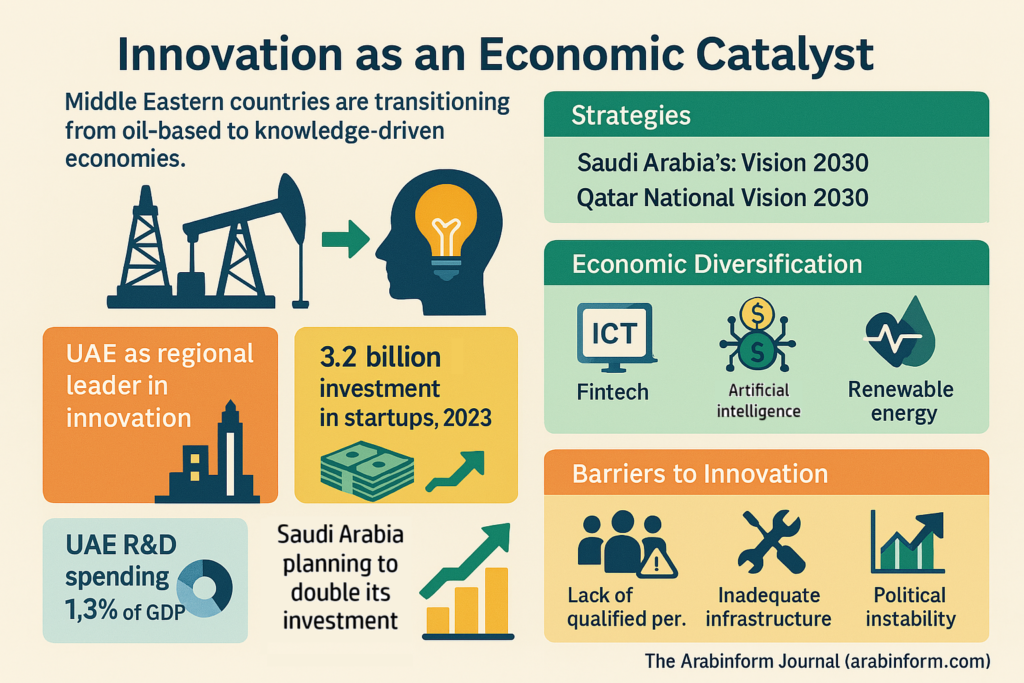
For instance, the UAE has become a regional leader in innovation. Through massive investments in infrastructure and the creation of technology hubs such as Dubai Internet City and Dubai Design District, the country has established a robust startup ecosystem. It now ranks among the top innovation performers in the Middle East. Saudi Arabia, meanwhile, has launched initiatives like NEOM—a futuristic smart city project that integrates artificial intelligence and clean energy—as part of its broader economic transformation.
Qatar is also actively investing in innovation infrastructure. Its national innovation strategy emphasizes scientific research and the development of high-tech industries, backed by platforms such as the Qatar Science and Technology Park (QSTP).
Economic Diversification and Digital Transformation
The drive for innovation in the Middle East is tightly linked to the need for economic diversification. Oil revenues, though still significant, are increasingly seen as unreliable due to price volatility and the global energy transition. This has prompted governments to promote non-oil sectors such as information and communications technology (ICT), financial technologies (fintech), healthcare, and renewable energy.
Bahrain, for example, has positioned itself as a regional fintech hub, creating a favorable regulatory environment and digital infrastructure to attract startups. The Bahrain FinTech Bay incubator supports projects in blockchain, AI, and cybersecurity. Although R&D expenditures in Bahrain remain modest (0.5% of GDP in 2023), plans are underway to double this figure by 2030.
Saudi Arabia and the UAE are leading in terms of innovation spending, with the UAE allocating 1.3% of its GDP to R&D, and Saudi Arabia planning to double its investment. In 2023 alone, startups in the region attracted $3.2 billion in investment, with 50% of deals focused on fintech and healthcare technologies.
Barriers to Innovation
Despite this progress, several structural issues continue to impede innovation. One of the most significant barriers is the lack of qualified personnel. Many countries in the region struggle with education systems that are misaligned with the demands of a high-tech labor market. There is also a shortage of researchers and technical specialists, particularly in STEM fields.
Insufficient public and private investment in R&D remains a critical limitation. While government funding is increasing, the absence of a strong venture capital culture hinders the commercialization of research and startup development. Furthermore, inadequate infrastructure, such as limited access to high-speed internet and modern laboratories, constrains innovation capacity.
Political instability and regional conflicts further complicate efforts to establish long-term innovation strategies. Countries like Yemen and Syria face ongoing crises that make it difficult to attract investment or retain talent. Even in more stable states, frequent policy shifts and governance issues can disrupt long-term planning and reduce investor confidence.
The Role of International Partnerships
International cooperation plays a vital role in overcoming these challenges. Partnerships with global tech firms, universities, and development organizations are helping Middle Eastern countries access advanced technologies and global expertise. The involvement of foreign investors and multinational corporations is also facilitating knowledge transfer and supporting startup development.
Bahrain’s success in attracting international fintech companies, such as Rain—a cryptocurrency firm that chose Bahrain as its regional headquarters—highlights the potential of strategic openness. In 2023, fintech investments in Bahrain surpassed $200 million.
Toward a Regional Innovation Ecosystem
Despite uneven progress, the Middle East is beginning to form a more cohesive regional innovation ecosystem. The Global Innovation Index (2024) ranks the UAE 31st worldwide, followed by Saudi Arabia at 54th and Qatar at 52nd. These rankings indicate that, while challenges remain, the region’s innovation capacity is steadily improving.
More than 20,000 patents were registered across the region in 2023, with a large share attributed to the UAE and Saudi Arabia. Increasing patent activity reflects not only enhanced research capabilities but also a growing focus on intellectual property protection and commercialization.
However, continued success will depend on deepening reforms. National innovation strategies must address gaps in education, gender and minority inclusion, legal frameworks, and private sector involvement. Measures such as tax incentives for startups, improved research funding mechanisms, and targeted skill development programs are essential.
Potential and Persistence
The innovation policies of Middle Eastern countries reflect a significant transformation in development priorities. Regional leaders like the UAE, Saudi Arabia, and Qatar are investing in technology, education, and research to build diversified and sustainable economies. Yet, long-term success will hinge on the consistent implementation of strategic reforms and the ability to adapt to emerging challenges.
As countries continue to reduce their dependence on oil and embrace innovation-led growth, the Middle East has the potential to become a global hub for technology and scientific advancement. The region’s accumulated experience and strategic investments suggest it is well positioned to contribute meaningfully to the next wave of global innovation.