


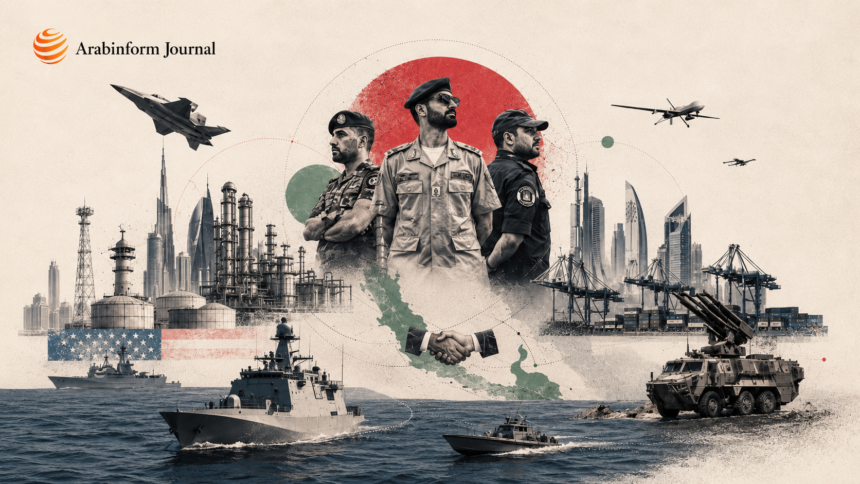
The security architecture of the Gulf is no longer built on a simple bargain: Western protection in exchange for energy stability. The United States remains the indispensable military actor, but Gulf states are increasingly asking a different question: can American power still guarantee security, or must it be converted into local capacity, regional diplomacy and selective autonomy?
A thinner umbrella
Recent tensions around the Strait of Hormuz have sharpened this debate. In March 2026, the UAE’s foreign ministry joined a statement calling freedom of navigation a principle of international law and warning that interference with shipping and energy supply chains threatened international peace and security. In June, Reuters reported that UAE Foreign Minister Sheikh Abdullah bin Zayed held a rare call with Iran’s foreign minister to stress maritime corridors, sovereignty and uninterrupted traffic through Hormuz. That was not a rejection of Washington. It was a signal that Gulf capitals cannot outsource crisis management entirely to Washington.
The shift is not toward neutrality. It is toward hedging. The White House said in November 2025 that a new Saudi-US strategic defense arrangement would make it easier for US defense firms to operate in Saudi Arabia, approve major defense sales and help Riyadh build its own capabilities. But the wording also reveals the direction of travel: America is increasingly an enabler of Gulf defense, not merely a guarantor standing above it.
Autonomy still depends on American systems
The paradox is that Gulf autonomy remains highly dependent on US hardware, training and command structures. SIPRI reported in 2025 that GCC states accounted for 20 percent of global arms imports in 2020–24, while Qatar, Saudi Arabia and Kuwait ranked among the world’s top ten arms importers. The United States supplied 74 percent of Saudi Arabia’s arms imports and 48 percent of Qatar’s during that period.
This suggests that regional autonomy does not mean strategic separation from Washington. It means acquiring enough capability to reduce vulnerability when US attention shifts, domestic politics constrain intervention, or escalation risks become too high. The real test is whether imported platforms can be integrated into joint air defense, cyber protection, maritime surveillance and rapid decision-making across the GCC.
Maritime security becomes regionalized
There are signs of this transition at sea. In September 2025, US Central Command said Qatar had assumed command of Combined Task Force 152, responsible for Gulf maritime security cooperation. A month earlier, Saudi Arabia assumed command of Combined Task Force 150, which conducts maritime security operations outside the Gulf against non-state threats. These rotations do not remove US leadership, but they normalize Gulf states as operators, not just protected clients.
Yet the limits are visible. A regional maritime system can patrol, deter and share intelligence, but can it keep Hormuz open during a major confrontation with Iran? Can Gulf states coordinate quickly when their threat perceptions differ? Oman and Qatar often prioritize mediation; Saudi Arabia, the UAE and Bahrain may emphasize deterrence. Regional autonomy will be weaker if it becomes six national strategies rather than one security architecture.
Security is now economic policy
The security question is inseparable from economic transformation. The IMF said in December 2025 that GCC economies had remained resilient despite external shocks, with robust non-hydrocarbon activity supported by domestic demand and reform momentum. But diversification depends on airports, ports, logistics corridors, tourism, data centers and investor confidence — all vulnerable to missile, drone, cyber and maritime disruption.
This is why Gulf security is moving beyond armies. It now includes supply chains, insurance premiums, desalination plants, AI infrastructure and financial reputation. A successful regional security model must protect not only oil exports but also the economic identities Gulf states are trying to build after oil.
A cautious outlook
The Gulf’s emerging security order is therefore hybrid. The United States will remain central because no alternative power can match its military reach, intelligence network and interoperability with Gulf forces. But the old model of passive reliance is fading. Gulf states want American technology, European and Asian partnerships, domestic defense industries, and open channels with Iran — all at the same time.
That strategy may be rational, but it is not risk-free. Too much autonomy could fragment collective defense; too much dependence could revive old vulnerabilities. The likely outcome is not a post-American Gulf, but a more transactional and more demanding one, where protection is measured less by promises and more by usable capacity in the next crisis.